
How to Master Wii Sports Baseball
Wii Sports

Welcome Pitchers and Batters!
Wii Sports simplifies Baseball to its core duel between pitcher and batter. Mastering the nuances of spin, timing, and power is the key to dominating the AI and your friends. This guide will walk you through the essential mechanics of pitching and batting, along with pro-level strategies to help you climb the ranks and earn the title of Pro.
Now, before we get into that, here's a little rundown of how the game works. In Wii Sports Baseball, the complex mechanics of professional baseball are distilled into a focused, three-inning matchup between a pitcher and a batter. Unlike traditional baseball titles, all fielding and base running are automated by the computer, allowing you to focus entirely on the duel at home plate.
A game consists of two teams of nine Mii characters. You will alternate between pitching to your opponent and batting against them until three innings are complete. If the score is tied at the end of the third inning, the game will go into Extra Innings until a winner is decided. Additionally, a Mercy Rule is in effect: if one team leads by five or more runs at the end of a full inning, the game ends immediately.
Batting Techniques
Success as a batter depends entirely on your timing and the angle of your swing.

Timing your swing
Early Swing: The ball goes toward the left field (for right-handed batters).
Late Swing: The ball goes toward the right field.
Perfect Timing: Hits the ball straight down the middle for the best chance at a home run.
Controlling flight
Home Runs: Swing from low to high to "under-cut" the ball and give it more loft.
Grounders: Swing from high to low to drive the ball into the dirt.
Bunting
Hold the Wii Remote horizontally to bunt. While usually an out, a well-placed bunt can sometimes land a single if it catches the AI off guard.
Pro Strategy: Tiring the Pitcher
As you face tougher AI, the pitcher will throw more variety. A key strategy is to work the count.
If you make the pitcher throw many pitches (by fouling them off or taking "balls"), they will eventually break a sweat.
When a pitcher is tired, a red exclamation mark (!) will appear over their head. This signifies a "meat pitch"—a slow, easy-to-hit ball that is perfect for a home run.
Common Pitfalls & Mistakes
Swinging at Every Pitch: One of the most common errors is being too aggressive at the plate. Higher-level AI will frequently throw balls (pitches outside the strike zone) to bait you into weak groundouts or pop-ups.
Misreading the Splitter: The Splitter is almost always a "ball." Many players swing because it looks like a standard fastball initially, but it drops sharply at the last second. You can recognize it by the lack of visible rotation (the seams don't appear to move) as it leaves the pitcher's hand.
Predictable Pitching Patterns: Throwing the same pitch twice in a row, especially at the Pro level, is a major mistake. The AI will adapt quickly and likely hit a home run on the second identical pitch. Always change your speed or type (e.g., follow a 90+ mph fastball with a slow curveball).
Neglecting the "Mercy Rule": You can actually end a game early if you have a lead of 5 or more runs at the end of the 1st or 2nd inning. Players often miss the chance to save time by not pushing for that 5th run early on.
Poor Wrist Flicking: Using your entire arm instead of a flick of the wrist can lead to slower pitches and less accurate swings. A quick snap is more effective for high-velocity fastballs.
Ignoring Fielding Errors: While fielding is automatic, the game includes a random "Error" mechanic where a Mii drops a ball (indicated by an exclamation mark). Don't assume an easy pop-up is a guaranteed out; always be prepared for the AI or your own team to fumble.
Understanding Base Hits
Single: This occurs when you hit the ball into the "gap" between the infield and outfield, or if it’s a sharp grounder that passes the infielders but is quickly scooped up by an outfielder.
Double: Usually the result of a powerful line drive that reaches the back wall (the fence) or a ball that lands deep in the "corners" (far left or far right field). If the outfielder has to run a long distance to fetch the ball, the game will automatically award you second base.
Triple: These are much rarer than doubles. A Triple typically happens if the ball hits the wall at a specific angle that causes it to bounce far away from the outfielder, or if an outfielder fumbles the ball (indicated by a "!" bubble) while it's deep in the field.
Home Run: Any ball that clears the outer fence entirely. A "Ground Rule Double" can also occur if the ball bounces over the fence, which automatically advances the batter to second base.
Tips for Better Base Hits
Watch the Outfielders: The AI outfielders move automatically toward the ball. If you see them running toward a corner, there’s a high chance your runner will stretch a single into a double.
Power Matters: Hits that travel high and fast are more likely to reach the wall, resulting in extra-base hits (Doubles and Triples).
Exploit Errors: If an outfielder makes an error, your Mii will automatically keep running to the next available base. You don't need to press any buttons to "take" the extra base; the game calculates the risk for you.
Pitching Mechanics
Pitching is the most strategic part of the game. You can control the type, speed, and position of the ball.
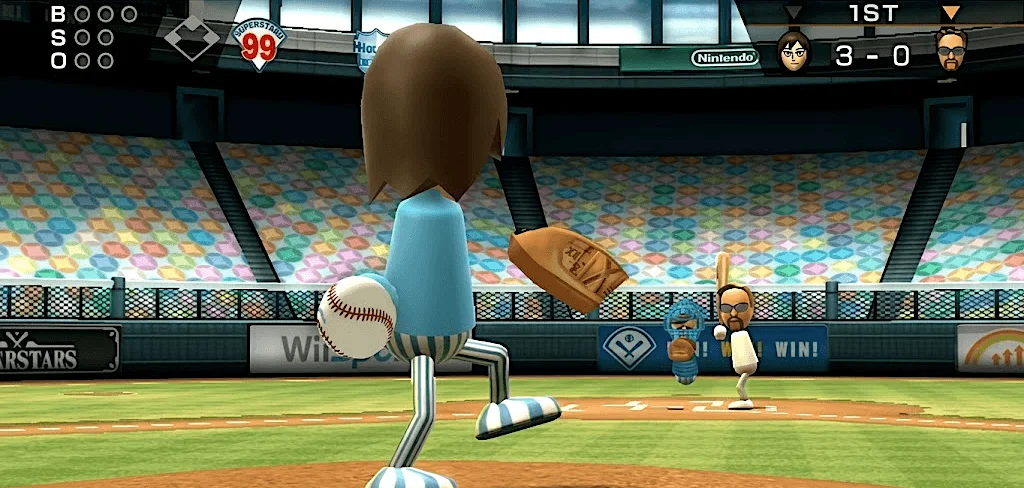
At its core, pitching is about managing the velocity and trajectory of the ball. Unlike batting, which is mostly about reaction, pitching allows you to dictate the pace of the game. You can control the horizontal position of your Mii on the rubber using the D-pad, which changes the angle at which the ball approaches the plate. This is particularly useful for making "inside" pitches harder to hit or creating a wider angle for breaking balls.
Fastball
The Fastball is the foundation of any pitcher's arsenal, executed by performing a clean throwing motion without holding any additional buttons. Its effectiveness is derived entirely from the physical speed of your delivery; a sharp, decisive flick of the wrist will result in a high-velocity pitch that can reach speeds over 90 mph. While it is the most predictable pitch in terms of movement, its raw speed is essential for blowing past batters who are expecting a slower, breaking ball.
Curveball
To introduce lateral movement that keeps hitters off-balance, the Curveball is your primary tool. By holding the (B) button during your delivery, the ball will take on a sweeping arc. If thrown by a right-handed pitcher, the ball will break away from a right-handed batter (and toward a left-handed one). This pitch is most effective when aimed at the outer edge of the strike zone, forcing the batter to reach and often resulting in weak pop-ups or "foul outs" if their timing isn't perfect.
Screwball
The Screwball serves as the mirror image of the Curveball and is triggered by holding the (A) button. This pitch breaks in the opposite direction, meaning a right-handed pitcher’s throw will curve sharply toward a right-handed batter. It is a devastating choice for jamming hitters or forcing them to swing at a ball that appears to be heading for the center of the plate before veering toward their hands. Using this in tandem with the Curveball creates a horizontal "guessing game" for the opponent.
Splitter
The Splitter is the ultimate deception pitch, requiring you to hold both the (A) and (B) buttons simultaneously. At the start of its flight, it mimics the trajectory and speed of a standard Fastball, but as it nears the plate, it suffers a dramatic vertical drop. Because the ball typically sinks below the strike zone, it is almost always a "ball" if the hitter has the discipline to let it pass. However, its sudden dip frequently baits aggressive players into swinging over the top of the ball, making it the most reliable way to secure a strikeout.
Advanced Controls
Mastering the advanced controls requires more than just a simple flick of the wrist; it involves a combination of positioning, delivery style, and speed control. Before you even begin your motion, you can use the D-pad to move your Mii left or right on the rubber, allowing you to change the starting angle of your pitch and catch the batter off guard.
The delivery itself can be customized by pressing (1) for a traditional overhand throw or (2) to switch to a sidearm or submarine style, which significantly alters how your Curveballs and Screwballs break across the plate. Finally, the velocity of your pitch is dictated by the intensity of your movement—a gentle flick produces a slow change-up, while a sharp, forceful snap can send a fastball screaming toward the catcher at over 90 mph.
Training Modes
Hitting Home Runs
Practice the low-to-high swing for distance.

Swing Control
Focus on timing to hit specific areas of the field.

Batting Practice
Hit as many pitches as possible as they increase in speed.

See You at the Base!
Mastering baseball is all about consistency and reading your opponent. By varying your pitches to keep hitters off-balance and perfecting your swing timing, you'll find yourself clearing the fences in no time. Keep practicing in the training modes to sharpen your skills, and soon you'll be the undisputed MVP of the neighborhood.
Comment posted.
0 Comments
You have to login to comment.